Sell or Hold Planner
What the portfolio report looks like
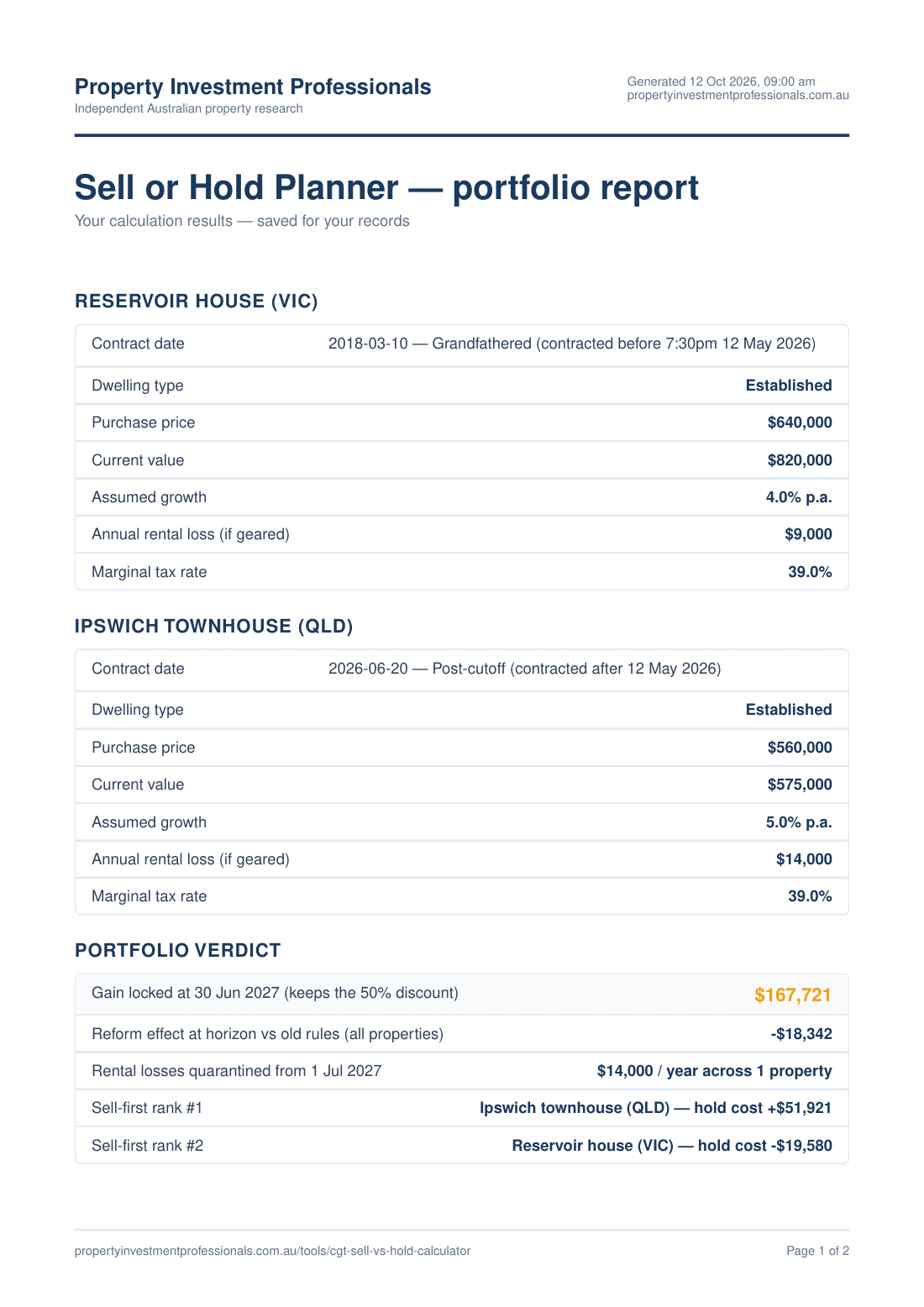
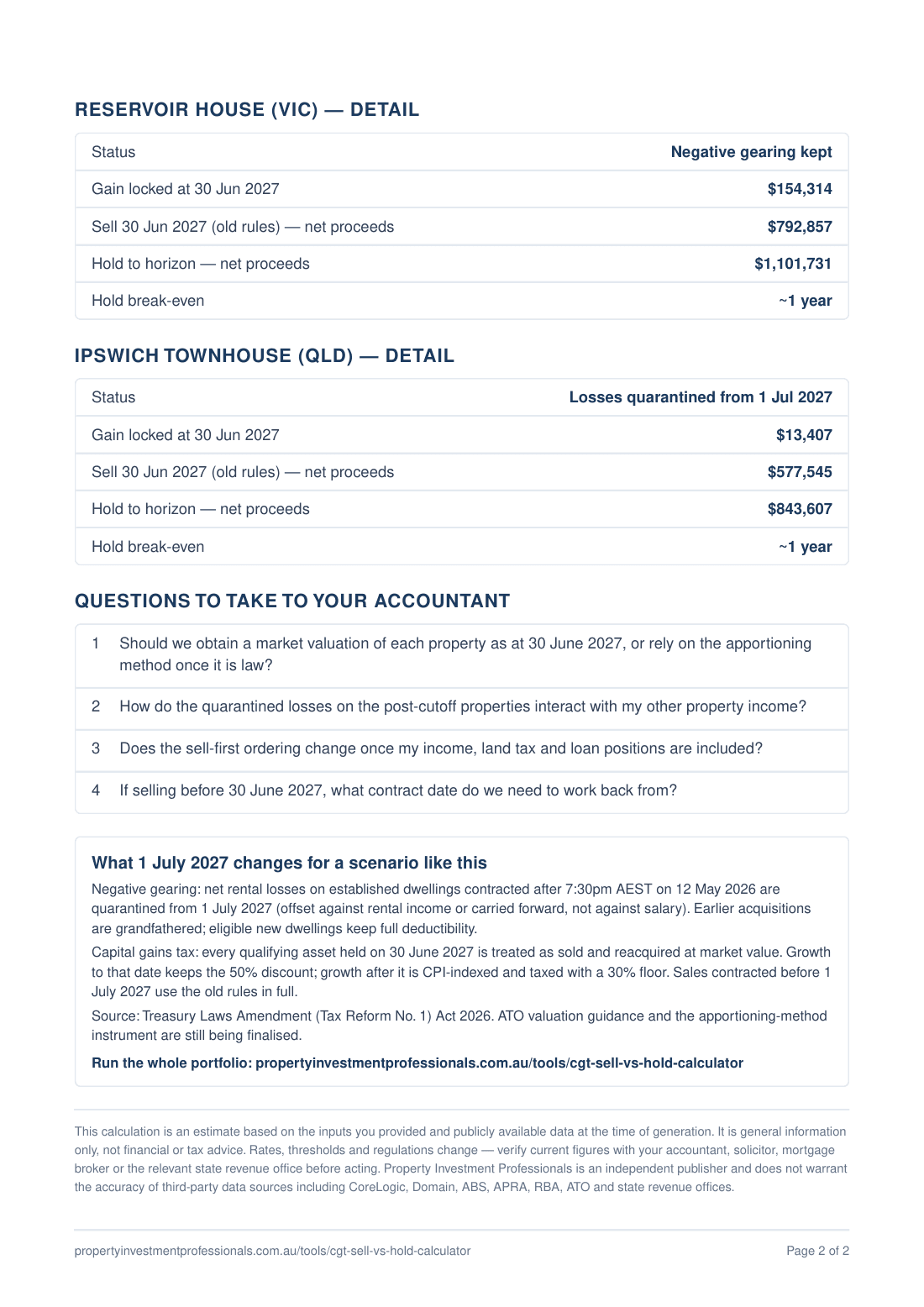
This is the exact PDF the planner emails, generated for a fictional two-property portfolio. Read it here without signing up, then run your own.
Quick answer
The report tags each property as grandfathered, quarantined or new-build under the enacted 2027 rules, shows the gain locked in at 30 June 2027 that keeps the 50% CGT discount, prices the cost of holding each property past the deadline, and ranks which to sell first. In this sample the post-cutoff townhouse ranks first because its rental losses are quarantined from 1 July 2027; the grandfathered house ranks last because the new CGT method actually saves tax on its later growth. It ends with four questions to take to an accountant.
The report, page by page
Two A4 pages, generated 12 October 2026. Every number below comes from the planner itself; nothing on this page is typed in by hand.
How to read the three numbers that matter
Gain locked at 30 June 2027. Every asset held by an individual on that date is treated as sold and reacquired at market value. The gain to that day keeps the 50% discount whenever the property is eventually sold. Across this portfolio it is $167,721, almost all of it in the house bought in 2018. Selling before the deadline protects nothing that is not already protected.
Hold cost to horizon. The modelled cost of keeping each property for the ten-year horizon: extra CGT on growth after 1 July 2027 under the indexed method versus the old discount, plus the tax value of rental losses that would be quarantined rather than offset against salary. The townhouse shows +$51,921, of which $50,682 is quarantined losses. The house shows −$19,580: a negative number means the new method costs less than the old one at the assumed growth rate.
Sell-first rank. Properties ordered by hold cost, highest first. It answers the portfolio question the single-property calculators cannot: if the tax settings argue for selling one, which one. It is a scenario on the assumptions entered, not advice, and it deliberately excludes rent, holding costs, land tax and what the proceeds would earn elsewhere.
The same report as text
For screen readers, search engines and anyone who prefers a table to an image.
Reservoir house (VIC)
| Contract date | 2018-03-10 — Grandfathered (contracted before 7:30pm 12 May 2026) |
| Dwelling type | Established |
| Purchase price | $640,000 |
| Current value | $820,000 |
| Assumed growth | 4.0% p.a. |
| Annual rental loss (if geared) | $9,000 |
| Marginal tax rate | 39.0% |
Ipswich townhouse (QLD)
| Contract date | 2026-06-20 — Post-cutoff (contracted after 12 May 2026) |
| Dwelling type | Established |
| Purchase price | $560,000 |
| Current value | $575,000 |
| Assumed growth | 5.0% p.a. |
| Annual rental loss (if geared) | $14,000 |
| Marginal tax rate | 39.0% |
Portfolio verdict
| Gain locked at 30 Jun 2027 (keeps the 50% discount) | $167,721 |
| Reform effect at horizon vs old rules (all properties) | -$18,342 |
| Rental losses quarantined from 1 Jul 2027 | $14,000 / year across 1 property |
| Sell-first rank #1 | Ipswich townhouse (QLD) — hold cost +$51,921 |
| Sell-first rank #2 | Reservoir house (VIC) — hold cost -$19,580 |
Reservoir house (VIC) — detail
| Status | Negative gearing kept |
| Gain locked at 30 Jun 2027 | $154,314 |
| Sell 30 Jun 2027 (old rules) — net proceeds | $792,857 |
| Hold to horizon — net proceeds | $1,101,731 |
| Hold break-even | ~1 year |
Ipswich townhouse (QLD) — detail
| Status | Losses quarantined from 1 Jul 2027 |
| Gain locked at 30 Jun 2027 | $13,407 |
| Sell 30 Jun 2027 (old rules) — net proceeds | $577,545 |
| Hold to horizon — net proceeds | $843,607 |
| Hold break-even | ~1 year |
Questions to take to your accountant
| 1 | Should we obtain a market valuation of each property as at 30 June 2027, or rely on the apportioning method once it is law? |
| 2 | How do the quarantined losses on the post-cutoff properties interact with my other property income? |
| 3 | Does the sell-first ordering change once my income, land tax and loan positions are included? |
| 4 | If selling before 30 June 2027, what contract date do we need to work back from? |
The fictional portfolio and its assumptions
- Reservoir house (VIC): established, contracted 2018-03-10, bought for $640,000 plus $34,000 acquisition costs and $15,000 of improvements, worth $820,000 today, growing 4.0% a year, running a $9,000 annual rental loss, owner on a 39% marginal rate, 3% selling costs, 10-year horizon, CPI 2.5%.
- Ipswich townhouse (QLD): established, contracted 2026-06-20, bought for $560,000 plus $22,000 acquisition costs, worth $575,000 today, growing 5.0% a year, running a $14,000 annual rental loss, owner on a 39% marginal rate, 3% selling costs, 10-year horizon, CPI 2.5%.
Neither property exists. Suburbs are named only to make the example readable. Models the enacted Treasury Laws Amendment (Tax Reform No. 1) Act 2026. Administrative detail (ATO valuation guidance, the apportioning-method instrument, the new-dwelling definition) is still being finalised. General information only, not financial or tax advice.
Run your own portfolio
Results appear on screen as you type, for one property or up to six. The email is only needed if you want this report as a PDF for your accountant.
Open the Sell or Hold PlannerGet the Sunday market brief
Auction clearance, prices, vacancy and the RBA read from the primary data every Sunday, plus the sell-or-hold countdown to the 1 July 2027 tax changes. Independent, nothing to sell.
Free. Unsubscribe in one click. We only use your email for the market brief. Privacy policy.